
Choosing the right keywords is not simply about finding the phrases with the highest search volume. A broad keyword can expose your website to a large audience, while a more specific phrase can tell you much more about what a searcher actually needs.
That is why the short-tail vs long-tail keywords decision should not be treated as a choice between two competing strategies. Both can be useful, but they serve different purposes. The right balance depends on your audience, website, competition, page type, business goals, and the level of specificity behind the search.
In this guide, you will learn how short-tail and long-tail keywords differ, when each type makes sense, how to research them, how to compare their potential value, and how to build a practical keyword strategy without chasing every possible keyword variation.
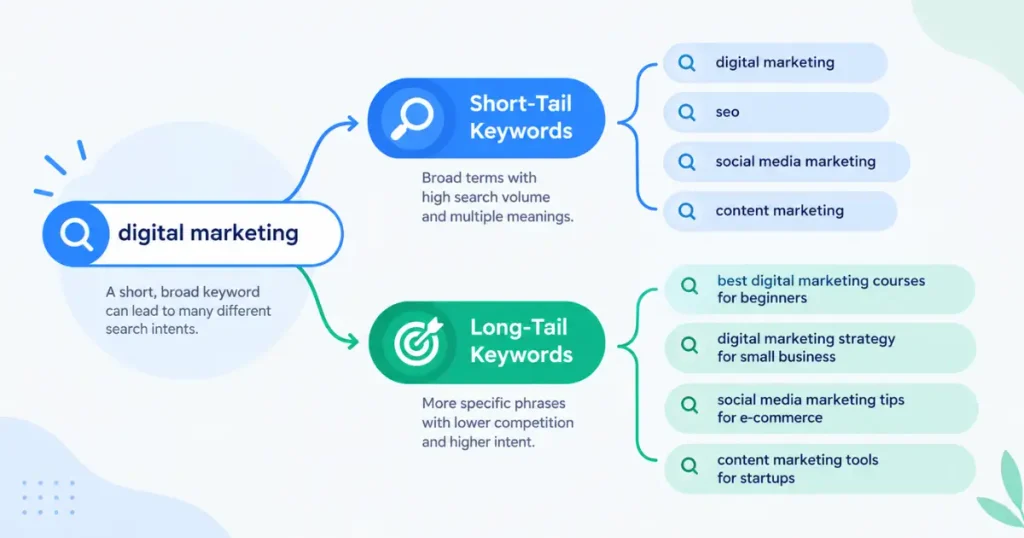
Table of Contents
What Are Short-Tail Keywords?
Short-tail keywords are broad search phrases that usually contain one or a few words. They typically describe a general subject or a vast category rather than a highly specific requirement. Because of their broad nature, they often attract a massive audience and high search volume, but the exact intent behind the search can remain ambiguous. Consequently, targeting them alone can make it challenging to pin down what the user truly wants.
Examples include:
- SEO
- digital marketing
- web design
- keyword research
- running shoes
- accounting software
- SEO services
These phrases usually describe a broad subject rather than a highly specific requirement.
For example, someone searching for “SEO” could be looking for:
- An SEO definition
- An SEO tutorial
- SEO tools
- SEO services
- An SEO course
- SEO news
- Help with a specific SEO problem
The keyword itself does not tell you exactly which answer the person wants.
That broadness is both the strength and weakness of short-tail keywords.
They can represent a large topic, but the audience behind the query can have very different goals.
Examples of Short-Tail Keywords
Consider these phrases:
| Short-Tail Keyword | What It Could Mean |
| SEO | Learning, tools, services, news, tutorials |
| web design | Learning, examples, agency, freelancer, pricing |
| laptops | Products, reviews, comparisons, specifications |
| running shoes | Buying, reviews, brands, recommendations |
| digital marketing | Learning, services, strategy, jobs, courses |
The broader the phrase, the more possibilities you may need to consider before deciding what type of content belongs around it.
What Are Long-Tail Keywords?
Long-tail keywords are more specific search phrases that usually contain additional words or details. Rather than targeting a broad category, they focus on precise user needs, specific questions, or niche requirements. Because they capture greater context about what the searcher is looking for, they often yield higher user intent and conversion potential. Consequently, incorporating them into your content helps you address exact problems and connect with a more targeted audience.
Examples include:
- how to do SEO for a small business
- best running shoes for flat feet
- affordable web design for small businesses
- local SEO services for plumbers
- best laptop for graphic design students
The important point is that long-tail does not simply mean “a keyword with many words.”
Specificity matters more than word count.
For example:
SEO tools
is relatively short, but it can represent several different needs.
On the other hand:
free SEO audit tools for small business websites
is much more specific.
The longer phrase tells you more about what the searcher is looking for.
Examples of Long-Tail Keywords
| Long-Tail Keyword | Information Revealed |
| best laptop for graphic design students | Product + audience + use case |
| SEO services for small businesses | Service + target audience |
| how to optimize a Google Business Profile | Task + platform |
| affordable web design for plumbers | Service + audience + business type |
| best running shoes for flat feet | Product + specific need |
This additional context can make long-tail queries useful for focused content and specific audiences.
Short-Tail vs Long-Tail Keywords: What’s the Difference?
The simplest way to understand the difference is:
Short-tail keywords are usually broader. Long-tail keywords are usually more specific.
Here is a practical comparison between short-tail vs long-tail keywords:
| Factor | Short-Tail Keywords | Long-Tail Keywords |
| Typical length | Shorter | Longer |
| Topic | Broad | Specific |
| Searcher information | Limited | More detailed |
| Possible meanings | Often many | Usually fewer |
| Audience | Broad | More targeted |
| Competition | Often competitive, but varies | Can be lower or high depending on query |
| Search volume | Often higher, but not always | Often lower individually, but not always |
| Content opportunity | Broad topic | Focused question or need |
| Business relevance | Depends on query | Often clearer when specific |
| Best use | Broad strategic topics | Specific needs and questions |
One important warning: do not treat this table as a ranking formula.
Not every short-tail keyword is highly competitive.
Not every long-tail keyword is easy to rank for.
The actual search results, industry, audience, topic, and commercial value all matter.
Why Keyword Length Alone Is Not Enough
Imagine two searches:
web design
and:
WordPress web design for small businesses
The second phrase gives you more information.
You can see:
- The platform
- The service
- The audience
But even then, keyword length does not tell you everything.
A longer query can still have several possible meanings.
Likewise, a short query can sometimes have a very clear purpose.
The better question is not:
“How many words are in this keyword?”
Ask:
“How much information does this search query give me about the person’s need?”
That is a much more useful way to evaluate keywords.
Why Search Intent Still Matters
Keyword research and search intent are closely connected.
If someone searches:
SEO
you may need to investigate what kind of results users expect.
If someone searches:
SEO services for small businesses
the commercial context is much clearer.
If someone searches:
how to improve SEO for a small business website
the query is more informational.
This is one reason it helps to understand search intent before deciding what type of content to create.
For a deeper explanation of how to study what users expect from a search, see our guide on search intent analysis.
The goal here is not to repeat that entire topic. The key point for keyword selection is simple:
A useful keyword strategy considers both the wording of the query and the need behind it.
Why Short-Tail Keywords Can Be Valuable
Short-tail keywords can play an important role in an SEO strategy because they often represent major topics within an industry.
For example, an SEO website may naturally cover:
- SEO
- technical SEO
- local SEO
- keyword research
- content optimization
These broad subjects help define the website’s overall areas of expertise.
They can also help you identify smaller topics that deserve more focused coverage.
Think of a short-tail keyword as a topic starting point, not necessarily the exact phrase every page should target.
Short-Tail Keywords Can Help Define Major Topics
Suppose your business provides digital marketing services.
A broad subject might be:
digital marketing
From that topic, you may discover more specific needs such as:
- digital marketing for small businesses
- SEO for local businesses
- Google Ads for service businesses
- website conversion optimization
- social media advertising
The broader keyword gives you the subject area.
The specific phrases reveal individual problems and opportunities.
Why Long-Tail Keywords Can Be Valuable
Long-tail keywords can be useful because they often contain more context.
Consider:
web design
versus:
web design for plumbing businesses
The second query tells you much more about the audience.
Another example:
SEO
versus:
SEO audit checklist for WordPress websites
The second query points toward a specific task.
This additional context can help you create a page that answers a clearly defined question.
Long-Tail Keywords Can Reflect Specific Problems
A specific search may reveal:
- A problem
- A product requirement
- A service need
- A target audience
- A location
- A budget
- A particular use case
- A comparison
- A desired outcome
That does not guarantee a conversion or ranking.
It simply gives you more information to work with.
Does Long-Tail Mean Low Competition?
No.
This is one of the most common assumptions in keyword research.
A long-tail keyword can still be competitive if it has strong commercial value or attracts significant interest.
For example:
best project management software for small businesses
is fairly specific, but there may still be many strong websites targeting it.
Likewise:
SEO services for small businesses
can be commercially valuable and competitive.
So don’t use this rule:
Long-tail = easy ranking
A better rule is:
Long-tail = more specific query
Competition is a separate question.
Does Short-Tail Mean High Search Volume?
Not automatically.
Shorter keywords often have broad meanings and may have substantial search demand, but keyword length itself does not determine search volume.
Search demand can vary based on:
- Industry
- Audience
- Location
- Language
- Season
- Current events
- Product demand
- Search behavior
A very specific phrase can sometimes have meaningful search demand, while an obscure short phrase may have very little.
So keyword research should be based on actual data rather than assumptions.
How to Research Short-Tail vs Long-Tail Keywords
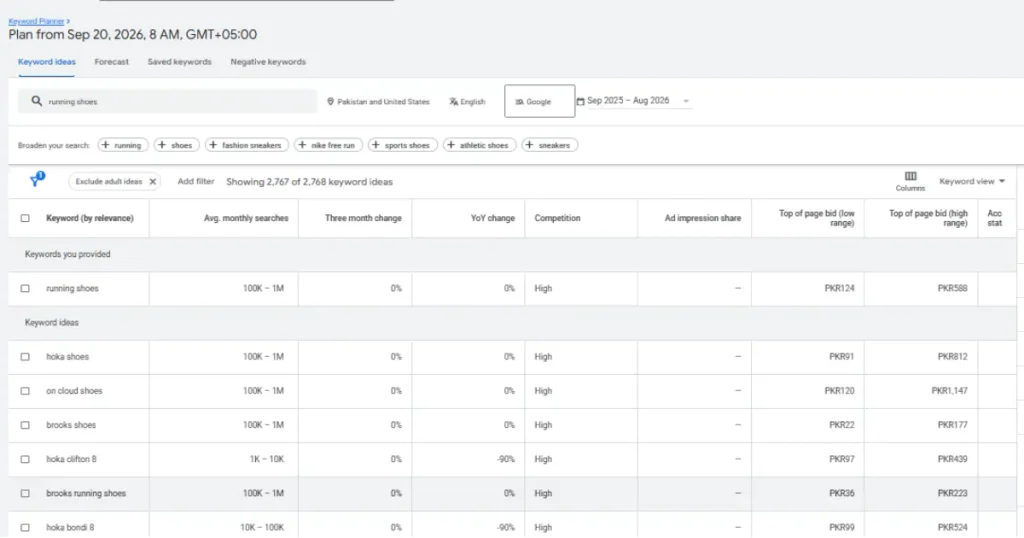
One practical starting point is Google Keyword Planner.
Google Keyword Planner is designed primarily for Google Ads keyword research, but it can also provide useful keyword ideas and estimates that help you understand how people search around a topic. Google says Keyword Planner can provide keyword ideas and estimates of searches, along with other planning data.
You can start with a broad seed phrase and examine the more specific ideas that appear.
For example, imagine your topic is:
running shoes
You might use that as the starting phrase and then examine more specific suggestions.
You could potentially find terms related to:
- running shoes for beginners
- running shoes for flat feet
- best running shoes for women
- running shoes for long distance
- affordable running shoes
The important part is not to copy every suggestion into your website.
Use the ideas to understand the different needs surrounding the topic.
Google Keyword Planner Can Help You Compare Keyword Ideas
Keyword Planner allows users to explore keyword ideas and examine metrics such as estimated monthly searches and advertising competition. Google also provides filters and location settings for refining the keyword ideas.
For example, you could compare:
| Keyword Type | Example |
| Broad | running shoes |
| More specific | running shoes for beginners |
| More specific | best running shoes for flat feet |
| Highly specific | best running shoes for flat feet for beginners |
You are not looking for the phrase with the biggest number automatically.
You are trying to understand which searches are relevant to your audience and which ones represent useful content opportunities.
Important: Keyword Planner Is Not an SEO Ranking Predictor
Keyword Planner is primarily a Google Ads research and planning tool.
Its data should not be treated as a guarantee of organic rankings.
Google also notes that its forecasts depend on factors such as bids, budgets, seasonality, location targeting, ad quality, and customer behavior.
For organic SEO, combine keyword research with:
- Search intent
- SERP analysis
- Topic relevance
- Content quality
- Audience needs
- Business value
- Your existing website structure
How to Find Long-Tail Keyword Opportunities From a Broad Topic
Start with a broad subject.
For example:
SEO
Then ask:
Who is searching?
A beginner may search differently from an experienced SEO professional.
What are they trying to do?
They may want to learn, compare, fix, buy, or hire.
What problem are they trying to solve?
A specific problem often produces a more specific query.
What details might matter?
These could include:
- Business size
- Industry
- Platform
- Location
- Budget
- Skill level
- Desired outcome
This process can turn a broad subject into useful, specific content opportunities.
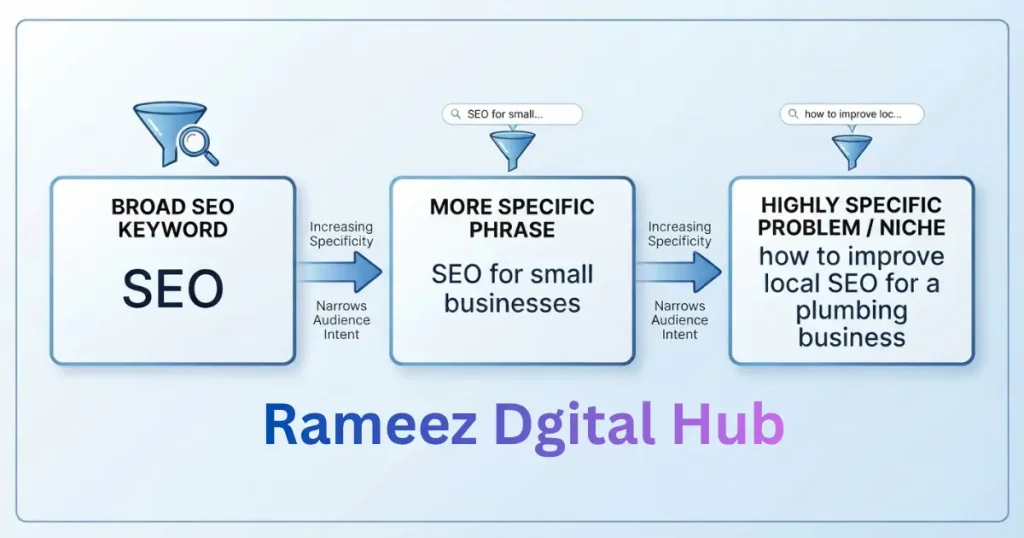
A Practical Example: From Short-Tail to Long-Tail
Let’s take the broad keyword:
SEO
Now imagine we narrow the topic based on different needs.
Level 1: Broad Topic
SEO
This could represent many different needs.
Level 2: Specific Area
SEO for small businesses
Now the audience is clearer.
Level 3: Specific Problem
how to improve SEO for a small business website
Now the search is focused on a task.
Level 4: Even More Specific Need
how to improve local SEO for a small plumbing business
The audience, service type, and SEO area are now much more specific.
Each step gives you more information.
But that does not mean Level 4 is automatically the best keyword.
The right choice depends on what you want the page to accomplish.
When Should You Target a Short-Tail Keyword?
A short-tail keyword can make sense when it represents an important broad topic for your website.
Consider targeting a broader keyword when:
- It accurately describes your subject
- The topic is important to your audience
- You can create a useful resource around it
- The page type matches what users expect
- The keyword has genuine business relevance
- You have a clear reason for covering the broader topic
For example, a company specializing in SEO may naturally have a page dedicated to SEO services.
A website selling running equipment may naturally have a category around running shoes.
The keyword should fit the page’s actual purpose.
When Should You Target a Long-Tail Keyword?
A long-tail keyword can be useful when the searcher’s need is specific.
Consider it when:
- The query describes a clear problem
- The audience is clearly defined
- The searcher has a specific question
- The topic deserves focused content
- The phrase is relevant to your business
- You can provide a useful answer
For example:
how to optimize a WordPress website for local SEO
has a much more specific purpose than:
SEO
A focused article can address that task without trying to cover every possible SEO topic.
Should a New Website Focus More on Long-Tail Keywords?
There is no universal percentage that every new website should follow.
A new website may find specific queries useful because they allow it to create focused resources around real user problems.
But that does not mean a new website should completely ignore broader topics.
The right approach depends on:
- Your niche
- Competition
- Audience
- Website authority
- Available resources
- Business model
- Content goals
For example, a new local service website and a large ecommerce website may need very different keyword strategies.
Instead of following a fixed formula, build your strategy around the opportunities that make sense for your site.
How to Balance Short-Tail vs Long-Tail Keywords
A balanced strategy gives both keyword types a role.
Use Broad Keywords to Define the Main Subjects
Start by identifying the major topics that matter to your audience.
For an SEO website, these might include:
- On-page SEO
- Technical SEO
- Local SEO
- Keyword strategy
- Content optimization
Use Specific Keywords to Explore Individual Needs
Then identify focused questions and problems around those subjects.
For example:
Broad subject:
Keyword strategy
Specific needs:
- short-tail vs long-tail keywords
- how to choose keywords for a small business
- how to find keyword opportunities
- how to evaluate keyword relevance
The important distinction is that this article should focus on the first comparison rather than becoming a complete guide to every aspect of keyword research.
Don’t Create a New Page for Every Keyword Variation
Keyword tools can generate many variations of the same basic idea.
For example:
- long-tail keywords
- long tail keywords
- long-tail keyword strategy
- long-tail SEO keywords
- SEO long-tail keywords
That does not automatically mean you need five separate articles.
First ask whether the searcher is looking for a genuinely different answer.
If the same page can satisfy the need naturally, one useful resource may be the better choice.
This keeps your website easier to navigate and prevents your content strategy from becoming unnecessarily fragmented.
How to Decide Which Keyword Is More Valuable
When comparing two keywords, don’t look at search volume alone.
Consider at least five questions.
1. Is It Relevant?
Does the keyword relate directly to your website, service, product, or audience?
If not, remove it from consideration.
2. Is the Audience Right?
A keyword may attract many people but still be a poor fit for your business.
3. Is the Need Clear?
A specific query can make it easier to understand what the searcher expects.
4. Can You Satisfy the Search?
You should be able to create a page that genuinely answers the query.
5. Does It Have Business Value?
Traffic is useful when it supports a meaningful goal.
That could be:
- Awareness
- Leads
- Sales
- Bookings
- Sign-ups
- Product discovery
- Brand exposure
The best keyword is not necessarily the one with the largest search number.
Search Volume vs. Relevance
Consider this simple example:
| Keyword | Search Volume | Relevance to a Small SEO Business |
| SEO | Potentially broad | Broad |
| SEO agency | More commercial | High |
| SEO services for small businesses | More specific | Very high |
| SEO services for plumbers | Highly specific | High if plumbers are the target market |
The last keyword might have a smaller audience.
But if the business specifically serves plumbers, that smaller audience could be more relevant.
This is why keyword selection should consider quality of traffic, not just quantity.
Can Long-Tail Keywords Bring Valuable Traffic?
Yes, they can.
But the value comes from relevance and user need, not simply because the keyword is long.
For example, imagine a website sells services to small businesses.
A visitor searching:
digital marketing
could be researching the subject generally.
A visitor searching:
digital marketing services for small businesses
has provided more information about what they are looking for.
That does not guarantee that the second visitor will become a customer.
But the query gives you a clearer indication of the problem and audience.
Can Short-Tail Keywords Drive Business Results?
They can, depending on the query and page.
A broad keyword may be commercially useful when its meaning aligns with a product or service.
For example:
SEO services
is short but commercially specific enough to indicate that the searcher may be looking for a service.
The lesson is important:
Do not classify keywords only by length.
Look at what the words actually communicate.
Short-Tail vs Long-Tail Keywords for Service Businesses
Service businesses can benefit from a mix of broad and specific phrases.
Imagine a web design company.
Broad subjects might include:
- web design
- WordPress web design
- website development
Specific searches might include:
- WordPress website design for small businesses
- affordable website design for plumbers
- mobile-friendly website design for local businesses
The broad terms help describe the service category.
The specific phrases help identify particular customer needs.
The right balance depends on who the business serves.
Short-Tail vs Long-Tail Keywords for Blog Content
Blog content often provides more opportunities for specific queries because users ask detailed questions.
For example:
Broad topic:
SEO
Specific article topic:
How to Perform Search Intent Analysis to Align Content With User Expectations
That second type of topic has a clearly defined educational purpose.
Your existing Search Intent Analysis article is a good example of why a website does not need to make every SEO article about the broad term “SEO.”
A specific article can solve one meaningful problem while still contributing to the broader subject.
Short-Tail vs Long-Tail Keywords for Ecommerce
Ecommerce websites can use both types in different parts of the site.
For example:
Category-level topic:
running shoes
More specific product need:
men’s trail running shoes
Specific product query:
waterproof men’s trail running shoes
The category page and product pages have different purposes.
The keyword should match the type of page being created.
You should not force a highly specific product phrase into a broad category page simply because it has useful search demand.
How to Use Google Keyword Planner for a Real Example
Let’s use a hypothetical example for a digital marketing website.
Start with:
digital marketing
Open Keyword Planner and use the broad phrase as your starting point.
Google’s current Keyword Planner documentation recommends using relevant seed keywords and allows you to refine results by factors such as keyword text, monthly searches, competition, location, and other filters.
You may then see more specific keyword ideas.
Instead of immediately choosing the keyword with the largest search estimate, separate the ideas into groups such as:
Broad:
- digital marketing
Service-focused:
- digital marketing services
Audience-focused:
- digital marketing for small businesses
Problem-focused:
- how to create a digital marketing strategy
Commercial:
- digital marketing agency for small business
Now you have more context.
The next step is to decide which opportunities actually deserve content or a service page.

Don’t Treat Keyword Planner Numbers as the Whole Strategy
Keyword Planner data can be useful, but numbers should not make the decision for you.
For example, one keyword might show higher average monthly searches.
Another might be much more relevant to your audience.
Another might fit a commercial page better.
Another might reveal a question that your existing content does not answer.
The correct decision depends on the purpose of your website and page.
Google also notes that search volume statistics can fluctuate and are influenced by factors such as location, date range, seasonality, and selected settings.
That is another reason to treat keyword metrics as research data, not absolute truth.
A Simple Keyword Selection Scorecard
When you have several keyword ideas, you can evaluate them using a simple scorecard.
| Question | Yes / No |
| Is the keyword relevant to my audience? | |
| Does it describe a real user need? | |
| Does it fit my website? | |
| Can I create a useful page around it? | |
| Does the page have a clear purpose? | |
| Does the query have business value? | |
| Have I checked the current search results? |
You do not need a complicated formula.
The purpose of the scorecard is to stop search volume from becoming the only decision-making factor.
Common Short-Tail vs Long-Tail Keywords Mistakes
Navigating keyword selection can be tricky, and even experienced marketers often fall into traps that waste budget or limit organic visibility. Recognizing these common pitfalls allows you to adjust your approach and get the maximum return from both short-tail and long-tail terms.
Mistake 1: Assuming Longer Always Means Better
A long-tail keyword can be useful, but length does not automatically make it valuable.
Relevance comes first.
Mistake 2: Assuming Shorter Always Means More Valuable
High search demand does not automatically mean high business value.
A broad keyword may attract a large audience that includes many people who have no need for your service.
Mistake 3: Chasing Search Volume Without Understanding the Audience
Ask who is searching and why.
A smaller but highly relevant audience may be more useful than a large unrelated one.
Mistake 4: Assuming Long-Tail Means Easy Rankings
Specific queries can still be competitive.
Always inspect the actual search results.
Mistake 5: Creating Content Before Understanding the Keyword
Don’t start writing simply because a keyword appears in a research tool.
First understand the topic and the user need.
Mistake 6: Creating Separate Content for Every Small Variation
Not every wording difference represents a different topic.
If the underlying need is the same, consider whether one useful resource can answer it.
Mistake 7: Forcing Keywords Into Sentences
Keyword phrases should fit naturally into the content.
Google describes excessive or unnatural repetition of keywords as keyword stuffing.
Write for the reader first.
How to Build a Balanced Keyword Strategy
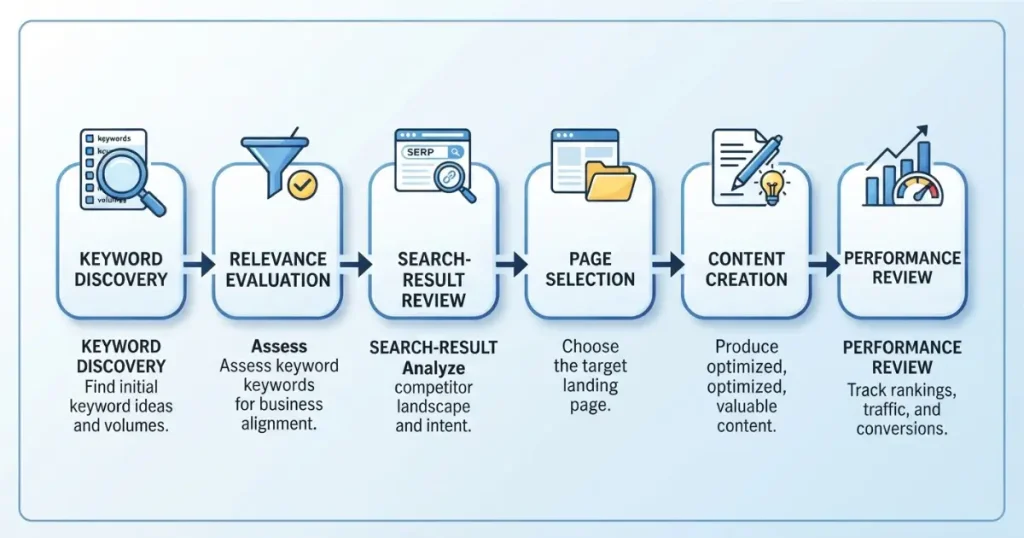
A practical process looks like this:
Step 1: Identify Your Main Topics
List the broad subjects that matter to your business.
Step 2: Find Specific User Needs
Look for questions, problems, use cases, and audience-specific searches around those topics.
Step 3: Research Actual Search Demand
Use keyword research tools such as Google Keyword Planner to discover ideas and examine available metrics.
Step 4: Check the Search Results
Look at what kind of pages are appearing.
Step 5: Evaluate Relevance
Remove keywords that attract an audience you do not actually serve.
Step 6: Decide What Kind of Page Is Needed
The query may call for:
- A service page
- Product page
- Category page
- Blog article
- Comparison
- Tutorial
- Resource
Step 7: Create the Most Useful Page
Don’t make the page longer simply because the keyword is competitive.
Make it more useful.
Step 8: Review Performance Later
After publishing, use your search and analytics data to see whether the page is attracting useful visitors.
This process gives short-tail and long-tail keywords different roles without forcing an artificial ratio.
How to Know If Your Balance Is Working
Your keyword strategy is working better when your content starts attracting the type of audience you actually want.
Depending on the website, useful signals can include:
- Organic clicks
- Search impressions
- Relevant search queries
- Qualified leads
- Contact form submissions
- Phone calls
- Sales
- Sign-ups
- Relevant engagement
For example, a service business should not celebrate traffic growth if most of the visitors have no interest in its services.
The better question is:
Are the people finding this page the people we actually want to reach?
That question can lead to better keyword decisions than search volume alone.
When Should You Review Your Keyword Strategy?
Keyword research should not necessarily be a one-time activity.
Revisit your strategy when:
- Your services change
- Your audience changes
- You launch a new product
- Search behavior changes
- A page attracts irrelevant traffic
- A topic becomes more important to your business
- Search results change significantly
- Your content stops matching user expectations
You don’t need to rebuild everything every month.
Review important pages when there is a clear reason to do so.
A Practical Short-Tail vs Long-Tail Keywords Checklist
Before choosing a keyword, ask:
- Is this keyword relevant to my business?
- Is it relevant to my audience?
- Is it broad or specific?
- What does the wording tell me about the searcher’s need?
- Does the current SERP support the page type I want to create?
- Is there genuine demand for the topic?
- Am I choosing it because of relevance or simply because of a large number?
- Can I provide something genuinely useful?
- Does this keyword fit an existing page or require a different page?
- Does the topic have meaningful business value?
- Would the page still be useful if search engines did not exist?
If the last answer is yes, you are probably moving in the right direction.
Short-Tail vs Long-Tail Keywords: Which Should You Choose?
There is no universal winner.
Short-tail keywords are useful for understanding and covering broad subjects.
Long-tail keywords are useful for addressing specific questions, audiences, problems, and needs.
A strong strategy can use both.
The important thing is to give each keyword a clear purpose.
Don’t chase every broad keyword.
Don’t ignore broad topics completely.
Don’t assume every long-tail keyword is easy.
And don’t create a separate page every time a keyword tool produces another variation.
Instead, look at the relationship between topic, audience, search need, page purpose, and business value.
That is what makes a keyword strategy practical.
FAQs
If you still have questions or want to fine-tune your approach, these FAQs provide additional clarity. Below, we answer the most common questions marketers face when choosing and balancing short-tail vs long-tail keywords for their campaigns.
What are short-tail and long-tail keywords?
Short-tail keywords are broad search phrases that usually describe a general topic. Long-tail keywords are generally more specific and provide additional context about what the searcher wants.
Are long-tail keywords better than short-tail keywords?
Not necessarily. Long-tail keywords can be useful for specific needs, while short-tail keywords can represent important broad topics. The better choice depends on the search query, audience, competition, page purpose, and business goals.
Are long-tail keywords easier to rank for?
Not always. Some long-tail queries may have less competition, but highly valuable specific queries can also be competitive. Keyword length alone cannot predict ranking difficulty.
Should new websites focus only on long-tail keywords?
No. Long-tail keywords can be useful for focused content, but new websites should still understand the broader subjects relevant to their audience. The right balance depends on the site’s niche and goals.
Can one page target short-tail and long-tail keywords together?
Yes. A focused page can naturally appear for a broad topic and related specific searches when the content genuinely addresses those needs. You do not need a separate page for every keyword variation.
Final Thoughts
The short-tail vs long-tail keywords decision is not about picking one type and ignoring the other.
Broad keywords help you understand the major subjects your website should cover. Long-tail keywords help you explore specific questions, problems, audiences, and use cases within those subjects.
The best approach is to start with your audience, understand what they need, research the language they use, check the actual search results, and then choose keywords that fit the purpose of your page.
Use tools such as Google Keyword Planner as research aids, not as automatic instructions for what to publish. Most importantly, don’t choose a keyword simply because it has a large number attached to it.
Choose the keyword that gives you the clearest opportunity to help the right person with the right information.
Ready to Scale Your Search Visibility?
Mastering the balance between short-tail vs long-tail keywords is essential, but executing a winning strategy takes time, deep technical expertise, and continuous optimization. At Rameez Digital Hub, we help businesses unlock their true organic potential through data-driven keyword research, technical SEO audits, and tailored content strategies. Don’t leave your rankings to chance—let our experts handle your growth while you focus on serving your clients.
Explore Our Services or Contact Rameez Digital Hub today to get started on your customized SEO roadmap!