
Ranking for a keyword is not only about using that keyword on a page. You also need to understand what the searcher actually wants when they type that query into Google.
This is where search intent analysis becomes important. It helps you understand the reason behind a search, the type of information users expect, and the kind of content that is most likely to satisfy their needs.
When your content matches that expectation, you have a better chance of creating a useful page that serves the searcher instead of simply targeting a keyword.
Table of Contents
What Is Search Intent?
Search intent is the reason behind a user’s search query.
Someone searching for “what is technical SEO” is probably looking for an explanation. Someone searching for “best SEO tools” may be comparing different options. A person searching for “SEO services” may already be looking for a provider.
The words can look similar, but the expected result can be completely different.
For example:
- “what is local SEO” → wants information
- “best local SEO agencies” → wants to compare options
- “local SEO services” → may be looking for a service provider
- “Rameez Digital Hub” → wants to find a specific brand
Understanding these differences is the foundation of search intent analysis.
Instead of asking only, “What keyword should I target?”, you should also ask:
“What does the person expect to find after searching this keyword?”
That question can change how you structure the page, how much information you provide, what format you use, and what action you ask the visitor to take.
What Is Search Intent Analysis?
Search intent analysis is the process of examining a search query and the search results around it to determine what users are trying to accomplish.
It involves looking beyond the keyword itself.
You analyze things such as:
- The wording of the query
- Search modifiers
- The current Google results
- Content formats ranking for the query
- Search result titles
- Topics covered by competing pages
- User questions
- Commercial or transactional signals
- Local or geographic signals
- Freshness requirements
- The action the searcher is likely to take next
The goal is simple:
Create content that satisfies the actual purpose behind the search.
Google’s guidance emphasizes creating helpful, reliable, people-first content rather than content created primarily to manipulate search rankings.
That makes understanding the searcher’s expectation an important part of a modern SEO workflow.
Why Search Intent Analysis Matters for SEO
A page can target the right keyword and still perform poorly if it gives users the wrong type of answer.
Imagine someone searches:
“best website design services”
If the search results are mostly agency pages, service comparisons, pricing information, and portfolios, creating a 3,000-word definition of what website design means probably does not match the dominant intent.
The topic may be related.
The intent is not.
This is why search intent analysis should happen before you spend hours writing a page.
It helps you choose the right content format
A keyword may require:
- A blog post
- A detailed guide
- A comparison
- A product page
- A service page
- A landing page
- A category page
- A local page
- A tutorial
- A review
- A calculator or tool
It helps improve relevance
When your page answers the questions users actually have, the content becomes more useful and easier to navigate.
It can improve conversions
Intent is not limited to informational searches.
If someone is ready to hire an SEO company, sending them to a generic educational article may create unnecessary friction.
A relevant service page may be a better destination.
For businesses that want to turn organic traffic into leads, this connection between search intent and conversion matters.
SEO & Organic Growth Services →
The 4 Main Types of Search Intent
Most search queries can be grouped into four broad categories:
- Informational
- Navigational
- Commercial Investigation
- Transactional
These categories are useful for search intent analysis, but remember that real searches are not always perfectly separated.
A query can have more than one possible interpretation.
Let’s look at each type.
1. Informational Search Intent
Informational searches happen when someone wants to learn something, solve a problem, or understand a topic.
Examples include:
- What is technical SEO?
- How does Google Search Console work?
- How to optimize a website?
- What is search intent?
- How do backlinks work?
The searcher is primarily looking for information.
Best content formats
Informational intent usually works well with:
- Guides
- Tutorials
- How-to articles
- Explanations
- Checklists
- Educational resources
- Step-by-step content
For example, someone searching “how to perform search intent analysis” probably expects a practical guide rather than a service advertisement.
That means the introduction should answer the question quickly, followed by a clear process and useful examples.
2. Navigational Search Intent
Navigational searches happen when users are trying to reach a specific website, brand, platform, or page.
Examples:
- Google Search Console
- Rameez Digital Hub
- Ahrefs login
- WordPress
The user already has a destination in mind.
For example, someone searching for “Rameez Digital Hub” is probably not asking for a general explanation of digital marketing.
They are trying to find the brand.
Best content or destination
For navigational searches, the ideal result is usually:
- Official website
- Brand page
- Login page
- Specific product page
- Contact page
- Official social profile
This is one reason strong brand architecture matters.
3. Commercial Investigation Intent
Commercial investigation happens when someone is researching options before making a decision.
The user may not be ready to buy immediately, but they are getting closer.
Examples:
- Best SEO agency
- SEO services vs PPC
- Best SEO tools for small businesses
- WordPress vs Webflow
- Best website design company
- SEO agency pricing
The searcher wants information, but the information is connected to a potential purchase or decision.
Useful content formats
Commercial searches often work well with:
- Comparisons
- Reviews
- Alternatives
- “Best” lists
- Case studies
- Service comparisons
- Detailed buying guides
- Pricing explanations
This is where search intent analysis becomes particularly useful because you need to understand how much commercial information the visitor expects.
For example, a user searching “SEO agency pricing” may want pricing ranges, factors that affect cost, service differences, and what they should expect from an agency.
A generic article explaining SEO would probably miss the point.
4. Transactional Search Intent
Transactional searches indicate that the user is ready to take an action.
That action could be:
- Buy
- Book
- Hire
- Sign up
- Download
- Request a quote
- Contact a business
Examples:
- Buy SEO software
- Hire an SEO agency
- SEO services
- Book a web designer
- Download SEO audit template
The best page for transactional intent is usually designed to make the desired action easy.
That could mean:
- A service page
- Product page
- Landing page
- Booking page
- Contact page
- Checkout page
The content should still answer important questions, but it should not bury the main action under unnecessary information.
Search Intent Can Change With the Query
One of the biggest mistakes in search intent analysis is assuming that small keyword changes do not matter.
They can.
Compare:
“SEO”
with:
“SEO services”
and:
“SEO services for small businesses”
These queries are related, but the user’s expectations may be different.
The first is extremely broad.
The second has a stronger commercial signal.
The third provides additional context about the target audience.
Another example:
- “plumber”
- “plumber near me”
- “emergency plumber”
- “how to fix a leaking pipe”
The first could have several meanings.
The second has a strong local signal.
The third has an urgent service intent.
The fourth is primarily informational.
This is why you should analyze the complete query rather than classifying intent from one word.
How to Perform Search Intent Analysis Step by Step
Now let’s move from theory to the actual execution. Here is a practical, step-by-step workflow to analyze live search results, understand user expectations, and build content that accurately matches search intent.
Step 1: Start With Your Target Keyword
Begin with the keyword or query you want to target.
For example:
search intent analysis
Don’t immediately start writing.
First, identify:
- What the keyword means
- Who is searching it
- Why they might be searching it
- What problem they are trying to solve
- What stage they are at in their decision-making process
Write down your initial assumption.
Then test that assumption against the actual search results.
Step 2: Search the Keyword on Google
Open Google and search the exact keyword.
This is one of the most valuable steps in search intent analysis because the current search results provide clues about what Google is showing users for that query.
Look at the first page.
Ask:
- Are the results mostly guides?
- Are they service pages?
- Are they product pages?
- Are they comparison articles?
- Are they videos?
- Are they local businesses?
- Are there forums or community discussions?
- Are results dominated by major brands?
- Do the pages appear recent?
Don’t look at just one result.
Study the overall pattern.
Step 3: Analyze the Top Results
Open several of the strongest relevant results.
You don’t need to copy them.
You need to understand what type of page Google is currently presenting.
Create a simple table:
| Result | Content Type | Main Topic | Intent |
| Result 1 | Guide | Search intent | Informational |
| Result 2 | Guide | Intent research | Informational |
| Result 3 | Tutorial | Intent analysis process | Informational |
| Result 4 | Blog | Keyword intent | Informational |
| Result 5 | Guide | SERP analysis | Informational |
The exact results will change over time, so this analysis should be based on the SERP you see when you’re creating or updating the content.
Step 4: Identify the Dominant Content Format
One of the strongest signals in search intent analysis is the format of the pages ranking.
Suppose you search:
“how to perform keyword research”
and most results are step-by-step guides.
That tells you something.
A simple 300-word definition probably won’t satisfy the same expectation as a detailed tutorial.
Likewise, if a query produces mostly service pages, writing a purely educational article may not be the best match.
Look for patterns
If most results are:
- Guides → users want detailed information
- Product pages → users may want to buy
- Service pages → users may want to hire
- Comparisons → users are evaluating options
- Reviews → users want experience and evidence
- Local listings → geographic intent matters
- Videos → visual explanation may be useful
Don’t treat these as absolute rules.
Use them as signals.
Step 5: Identify the Searcher’s Job to Be Done
A useful way to improve search intent analysis is to ask:
What job is the searcher trying to complete?
For example:
“How to fix slow WordPress website”
The job may be:
Diagnose the problem and learn how to make the website faster.
“Best SEO agency in Pakistan”
The job may be:
Compare providers before contacting one.
“SEO audit service”
The job may be:
Find someone who can perform an SEO audit.
Once you understand the job, content planning becomes easier.
Step 6: Look at Search Modifiers
Certain words provide strong clues about intent.
Informational modifiers
- What
- Why
- How
- Guide
- Tutorial
- Meaning
- Definition
- Examples
Commercial modifiers
- Best
- Top
- Review
- Comparison
- Vs
- Alternatives
- Pricing
- Cost
Transactional modifiers
- Buy
- Hire
- Book
- Order
- Service
- Quote
- Near me
Navigational modifiers
- Login
- Official
- Website
- Contact
- Address
These aren’t rigid categories.
A word like “best” often indicates commercial research, but you should still check the actual SERP.
Step 7: Check People Also Ask and Related Searches
Google can provide additional clues about what users want to know.
Look at:
- People Also Ask
- Related searches
- Autocomplete suggestions
- Search refinements
These can reveal related questions and subtopics.
For example, someone searching “search intent analysis” may also want to know:
- What is search intent?
- What are the types of search intent?
- How do I identify search intent?
- Why is search intent important?
- How do I match content to search intent?
These questions can help you build a better outline.
However, don’t turn every related question into a separate section.
Only include questions that genuinely support the main topic.
Step 8: Analyze Titles and Search Result Language
Look at how ranking pages describe themselves.
Pay attention to recurring terms.
For example, if several pages use words such as:
- Guide
- Complete
- Step-by-step
- Examples
- Types
- How to
that can indicate an educational expectation.
If you see:
- Pricing
- Services
- Agency
- Packages
- Hire
the intent is more commercial.
This is another useful layer of search intent analysis.
Step 9: Compare Your Existing Page
If you already have a page targeting the keyword, compare it with the current SERP.
Ask:
- Does my page answer the same question?
- Is my content format appropriate?
- Is the page too broad?
- Is it too shallow?
- Is it outdated?
- Does it answer important user questions?
- Is the introduction clear?
- Does the page satisfy the searcher’s next step?
- Is the CTA appropriate?
You may discover that the problem isn’t your keyword.
The problem may be intent mismatch.
Step 10: Map Intent to the Right Page
Not every keyword deserves a blog post.
This is an important part of search intent analysis.
Suppose you have these keywords:
| Keyword | Likely Intent | Suitable Page |
| What is technical SEO? | Informational | Blog |
| Technical SEO checklist | Informational | Guide |
| Technical SEO services | Transactional | Service Page |
| Best technical SEO agency | Commercial | Comparison/Service Content |
| Rameez Digital Hub | Navigational | Homepage/Brand Page |
This prevents you from trying to rank one page for every variation.
It also helps create a cleaner website structure.
Step 11: Build the Content Outline Around the Intent
Once you understand the searcher’s goal, build your outline.
Don’t start with:
“How many keywords can I put in this article?”
Start with:
“What information does the searcher need to complete their task?”
For an informational query, your outline might include:
- Definition
- Why it matters
- Types
- Step-by-step process
- Examples
- Common mistakes
- Practical checklist
- FAQs
The structure should depend on the query.
Step 12: Create a Better Answer, Not Just a Longer One
Longer content isn’t automatically better.
A 4,000-word article can still fail if the first 1,000 words don’t answer the user’s question.
Good content should provide:
- A clear answer
- Useful examples
- Logical organization
- Appropriate depth
- Relevant supporting information
- Practical steps
- Easy navigation
The goal of search intent analysis is not to make the longest possible page.
It is to make the most useful page for that particular search.
Search Intent Analysis and Keyword Research
Keyword research and search intent analysis are connected, but they are not the same thing.
Keyword research asks:
What are people searching for?
Search intent analysis asks:
Why are they searching for it, and what do they expect to find?
For example, keyword research may reveal:
“SEO audit”
But that doesn’t tell you everything.
The user could be looking for:
- An SEO audit definition
- An SEO audit checklist
- An SEO audit tool
- An SEO audit tutorial
- An SEO audit service
The search results can help determine which interpretation dominates.
That’s why keyword selection should not happen in isolation from intent.
Search Intent Analysis vs. Keyword Intent
These terms are often used interchangeably, but they can be approached slightly differently.
Search intent focuses on the user’s purpose.
Keyword intent often refers to the intent signals associated with a specific keyword or query.
In practical SEO work, you can use both concepts together.
The important question remains:
What does the person expect Google to show them for this search?
How to Match Search Intent With Content Format
Different intentions call for different content experiences.
| Search Intent | User Goal | Suitable Content |
| Informational | Learn | Guide, tutorial, article |
| Navigational | Find something | Brand/official page |
| Commercial | Compare | Comparison, review, case study |
| Transactional | Take action | Service/product/landing page |
This doesn’t mean every keyword fits perfectly into one box.
For example, a commercial query might benefit from a comparison article with a clear service CTA.
The key is to understand the dominant expectation.
Search Intent Across the Content Funnel
Intent also changes as people move through the buying journey.
Awareness
At this stage, users are often trying to understand a problem.
Examples:
- What is SEO?
- Why is my website not ranking?
- How does Google Search work?
Educational content is usually appropriate.
Consideration
Now the user is evaluating possible solutions.
Examples:
- Best SEO strategy for small businesses
- SEO vs PPC
- Best SEO tools
- SEO agency vs freelancer
Comparison and research-based content can work well here.
Decision
The user is closer to taking action.
Examples:
- SEO services
- SEO agency pricing
- Hire SEO consultant
- SEO audit service
A relevant service or conversion-focused page may be more appropriate.
This is why search intent analysis can help connect SEO traffic with actual business goals.
How to Handle Mixed Search Intent
Some keywords have mixed intent.
For example:
“SEO tools”
A user may want:
- A list of tools
- Reviews
- Pricing
- Free options
- Features
- Recommendations
If the SERP contains several types of content, don’t force the query into one category.
Instead, look for the dominant pattern and consider whether your page can satisfy multiple closely related needs.
For example, an article could provide:
- Short explanation
- Tool categories
- Recommended options
- Comparison table
- Pricing information
- How to choose
- Next steps
This approach can make the page more useful without creating unnecessary separate pages.
Search Intent Analysis for Local Searches
Local searches deserve special attention.
Consider:
“dentist”
versus:
“dentist near me”
versus:
“best dentist in Lahore”
versus:
“emergency dentist Lahore”
Each query contains different signals.
A local service business should understand:
- Location
- Service
- Urgency
- Business type
- Customer need
- Expected action
For example, “emergency dentist Lahore” suggests a much stronger immediate-service need than a broad informational query about dental care.
This is where search intent analysis overlaps with local SEO, but we should keep the focus on intent rather than turning this article into a complete local SEO guide.
How Search Intent Analysis Helps Service Businesses
Service businesses often make one common mistake:
They create blog content for informational keywords but don’t connect that traffic to relevant commercial pages.
For example, a digital marketing company might publish:
“What Is SEO?”
But someone searching:
“SEO services for small businesses”
needs a very different page.
That commercial query may be better served by a dedicated service page explaining:
- Services offered
- Process
- Benefits
- Suitable businesses
- Expected deliverables
- FAQs
- Proof or case studies
- Contact options
For technical SEO-related searches, a dedicated service page can also be more appropriate than forcing every query into a blog post.
For analytics-related searches, users may expect information about measurement, reporting, and data analysis.
Analytics & Reporting Services →
How to Use Search Intent Analysis for Commercial Content
Commercial pages need a different approach from educational articles.
Suppose someone searches:
“web design services”
They may want to know:
- What services are included?
- Can the website be customized?
- Is it mobile-friendly?
- What is the process?
- How much does it cost?
- Can the website generate leads?
- How can they get started?
A page targeting this intent should make those answers easy to find.
It shouldn’t spend most of its space explaining the history of websites.
For users looking for professional website design and UX services, a dedicated service page is usually more relevant.
How Search Intent Analysis Helps Paid Campaigns
Search intent is not limited to organic SEO.
It can also help with paid campaigns.
A search such as:
“SEO agency pricing”
has a different expectation from:
“what is SEO”.
If an advertisement targets a high-intent query, the landing page should provide a relevant experience.
The message should make sense from:
Search query → Ad → Landing page → Conversion
When these elements are aligned, the visitor doesn’t have to figure out why they landed on the page.
For businesses running Google Ads or Meta campaigns, this type of message alignment can be valuable.
Common Search Intent Analysis Mistakes
1. Assuming the keyword tells you everything
A keyword alone does not always reveal the full expectation.
Always examine the search results.
2. Writing before checking Google
If you write the entire article before checking the SERP, you may discover too late that your chosen format doesn’t match the query.
Do your search intent analysis first.
3. Copying the top-ranking pages
SERP analysis is not a license to copy competitors.
Use ranking pages to understand:
- Format
- Coverage
- User expectations
- Common questions
- Content depth
Then create your own useful resource.
4. Making the content longer just to compete
Word count isn’t the goal.
If a 1,500-word page fully solves the problem, adding another 2,500 words of filler won’t automatically make it better.
5. Ignoring commercial intent
Some businesses publish only informational content.
They may attract visitors but fail to give those visitors an appropriate next step.
Always consider whether a keyword deserves:
- Blog content
- Service content
- Product content
- Comparison content
- Landing page
6. Forcing one page to rank for everything
A single page shouldn’t attempt to satisfy completely different intentions.
If users have clearly different needs, separate pages may be better.
7. Changing the intent of an existing page without a reason
Don’t turn an informational article into a sales page simply because you want more leads.
The page still needs to satisfy its original search purpose.
Instead, use relevant internal links and appropriate CTAs to guide interested visitors toward commercial pages.
How to Use Search Intent Analysis to Improve Existing Content
You don’t always need to create a new article.
Sometimes the better opportunity is improving a page you already have.
Start by identifying pages that:
- Have impressions but few clicks
- Rank lower than expected
- Have declining traffic
- Target important keywords
- Attract visitors who don’t convert
Then perform search intent analysis again.
Check the current SERP.
Ask:
Has the searcher’s expectation changed?
Maybe the ranking results now prefer:
- More practical guides
- Updated information
- Comparisons
- Local results
- Product pages
- Shorter direct answers
If your page no longer matches the dominant intent, update the structure.
Don’t change content randomly.
Change it because the user’s needs or SERP expectations justify the change.
Search Intent Analysis and Keyword Cannibalization
Search intent can also help you understand why multiple pages may compete for similar keywords.
Imagine a website has:
- “What Is SEO?”
- “SEO Guide”
- “SEO Services”
- “Best SEO Services”
- “SEO Strategy”
These pages may target related phrases, but they shouldn’t all serve exactly the same purpose.
A useful content strategy separates them according to user needs.
For example:
- Educational intent → guide
- Strategy intent → strategy article
- Commercial investigation → comparison/service-related content
- Transactional intent → service page
When two pages target similar keywords, search intent can help you decide whether they should remain separate or be combined. If the pages satisfy different user needs, keeping them separate may make sense. If they serve the same intent, combining the content can create a clearer and more useful resource.
Advanced Signals to Look for During Search Intent Analysis
Once you’re comfortable with the basics, look for deeper signals.
Audience
Who is searching?
A beginner may need an explanation.
An experienced SEO professional may want technical implementation details.
Location
Does the query include a city, country, neighborhood, or “near me” modifier?
Location can change the type of results users expect.
Urgency
Words such as:
- Emergency
- Immediate
- Today
- Open now
can indicate a stronger need for quick action.
Freshness
Some searches require current information.
For example:
- Google algorithm updates
- Software features
- Current pricing
- Advertising policies
- Search features
For these topics, older content may not meet user expectations.
Format
Does the user appear to want:
- Text?
- Video?
- Images?
- A comparison?
- A tool?
- A calculator?
- A list?
The SERP can provide useful clues.
Search Intent Analysis Template
You can use this simple template before creating any important page.
| Question | Your Answer |
| Target keyword | |
| Who is searching? | |
| What is their main goal? | |
| Primary intent | |
| Secondary intent | |
| Main SERP format | |
| Common ranking page types | |
| Important user questions | |
| Freshness required? | |
| Local intent? | |
| Commercial signal? | |
| Best content format | |
| Main CTA | |
| Relevant internal links |
This makes search intent analysis much easier to repeat across different keywords.
A Practical Search Intent Analysis Example
Let’s use a simple, practical example to see how search intent analysis works in real life—taking a specific keyword from initial SERP evaluation all the way to final content mapping.:
Keyword:
“SEO services for small businesses”
Step 1: Understand the wording
The phrase includes:
- SEO services
- Small businesses
This suggests a commercial audience.
Step 2: Ask what the user wants
They may be looking for an SEO provider that understands small-business needs.
Step 3: Check Google
Look at the current results.
If the SERP is dominated by:
- SEO agencies
- Service pages
- Packages
- Guides comparing providers
the commercial signal becomes stronger.
Step 4: Choose the page type
A dedicated service page may be more appropriate than a general educational article.
Step 5: Determine what the page should answer
The visitor may want:
- What services are included?
- Who is the service for?
- What SEO activities are performed?
- How does the process work?
- What results should businesses expect?
- How can they get started?
Step 6: Provide the next action
A clear contact or consultation CTA makes sense.
This is the practical value of search intent analysis: it helps you move from keyword selection to page purpose.
How Search Intent Analysis Fits Into Your Content Strategy
Before publishing a new article, ask three questions:
1. What does the user want?
This defines the search intent.
2. What page should satisfy that need?
This defines your content format.
3. What should the visitor do next?
This defines your CTA and internal linking strategy.
For example:
Informational article → related guide/service → contact
or:
Commercial comparison → service page → enquiry
This creates a more logical journey through your website.
If the content is supported by real experience, examples, and relevant expertise, you can also reinforce your brand’s credibility.
Internal Linking Based on Search Intent
Internal links should help the reader move to the next relevant piece of information.
Don’t add links simply because a page exists.
For example, after explaining how search performance data can reveal whether a page is meeting expectations, linking to an analytics service can make sense.
Likewise, when discussing technical problems affecting page experience, a technical SEO service may be relevant.
This approach creates a useful relationship between your informational content and your commercial pages.
Google recommends descriptive, reasonably concise link text so users and search engines can better understand the linked page.
And there is an important distinction:
Internal linking should help users and site structure. It should not be treated as a way to manipulate rankings through excessive or unnatural links. Google’s spam policies warn against link practices created primarily to manipulate search rankings.
How to Choose the Right CTA
Your CTA should match the user’s intent.
For informational content, a hard sales CTA may feel premature.
Instead, you could use:
Learn More About Our SEO Services
For commercial content:
Explore Our SEO Services
For transactional content:
Request a Consultation
For a broader digital marketing topic:
Get Started With Digital Marketing & SEO
At the end of this article, the strongest next step is a contact CTA because the reader has already learned how to analyze search intent and may want professional help applying it.
How to Measure Whether Your Content Matches Search Intent
Publishing the page is not the final step.
You should review performance over time.
Useful signals include:
- Search impressions
- Organic clicks
- Click-through rate
- Search queries
- Average position
- Organic traffic
- Engagement
- Conversions
- Leads
- Enquiries
Google Search Console can help you understand the queries and search performance associated with your pages.
But don’t judge success from rankings alone.
A page that ranks for a keyword but attracts the wrong audience may not create meaningful business results.
A page that brings qualified visitors and enquiries can be much more valuable.
When Should You Repeat Search Intent Analysis?
Search results can change.
User expectations can change.
Your competitors can change.
Google can also change how it presents search results and search features. Google’s Search Central documentation is regularly updated, so SEO workflows should not be treated as permanently fixed.
Consider revisiting search intent analysis when:
- Rankings suddenly decline
- Traffic changes significantly
- The SERP format changes
- New competitors appear
- Your page stops attracting relevant visitors
- The keyword becomes more commercial
- The topic becomes outdated
- Your existing content no longer answers the main questions
This doesn’t mean constantly rewriting pages.
It means reviewing important content when there is a meaningful reason to do so.
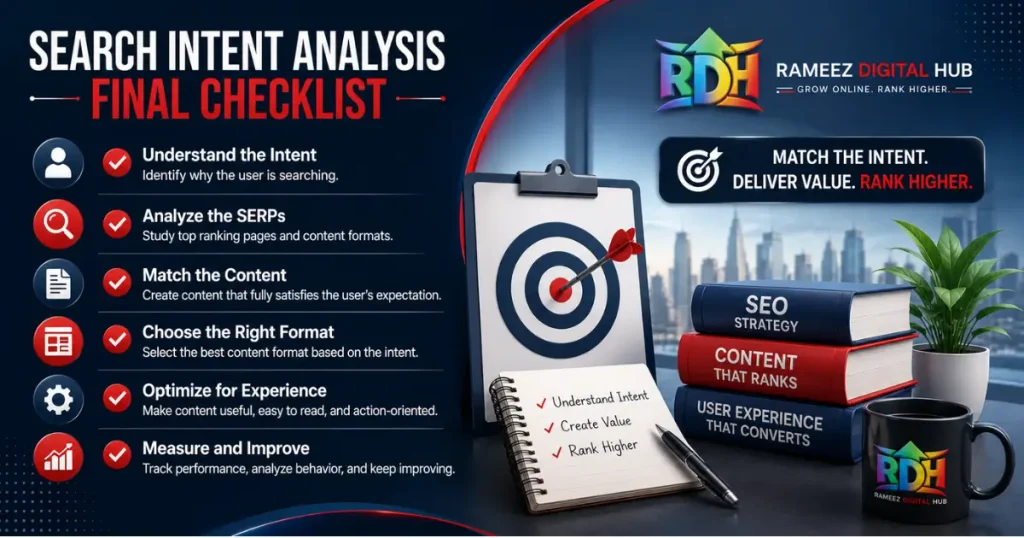
Final Search Intent Analysis Checklist
Before publishing a page, run through this checklist.
Keyword
- Is the target keyword clearly defined?
- Do I understand what the query means?
- Have I identified related queries?
Intent
- What is the main user goal?
- Is the intent informational, navigational, commercial, or transactional?
- Is there a secondary intent?
SERP
- Did I manually review the current Google results?
- What content formats dominate?
- What topics appear repeatedly?
- What questions are users asking?
- Is freshness important?
- Is there local intent?
Content
- Does the page format match the search?
- Does the introduction answer the main question quickly?
- Does the content cover the important needs?
- Are examples useful and relevant?
- Is the content easy to scan?
- Am I adding value instead of simply making the page longer?
Conversion
- Does the CTA match the user’s stage?
- Are relevant internal links included?
- Does the page guide the user toward a logical next step?
Quality
- Is the content written for people first?
- Is it accurate?
- Is it original?
- Does it demonstrate real knowledge or experience?
- Have I avoided unnecessary keyword repetition?
Google’s spam guidance specifically identifies excessive, unnatural repetition of keywords as keyword stuffing, so the focus keyword should be used where it genuinely fits rather than inserted mechanically.
FAQs About Search Intent Analysis
Find quick, practical answers to common questions about search intent analysis, content matching, and ranking expectations.
What is search intent analysis in SEO?
Search intent analysis is the process of understanding why someone searches for a particular query and determining what type of content is most likely to satisfy that need. It involves examining the query, SERP, ranking page formats, user questions, and other signals before creating or optimizing content.
What are the four types of search intent?
The four commonly used categories are informational, navigational, commercial investigation, and transactional. These categories help SEO professionals understand whether users are learning, finding a specific destination, comparing options, or preparing to take action.
How do I identify search intent for a keyword?
Start by searching the keyword on Google and studying the current results. Look at the types of pages ranking, their titles, topics, formats, search features, and the questions they answer. Then determine what the majority of results suggest about the user’s goal.
Why is search intent important for content?
Search intent helps you create content that matches what users expect to find. It can influence your page type, structure, depth, internal links, and CTA. Instead of creating content around a keyword alone, you build the page around the user’s actual need.
Can search intent change over time?
Yes. Search results and user expectations can change. A query that once produced mostly informational articles may later show more commercial, local, or current results. That’s why important pages should be reviewed when their performance or the SERP changes.
For more digital marketing questions, you can also explore Digital Marketing FAQs →
Final Thoughts
Search intent analysis changes the way you approach SEO content.
Instead of starting with keywords and immediately writing an article, you start with the person behind the search.
You ask what they want, what problem they are trying to solve, what type of page can help them, and what information they need next.
Then you use the current SERP to validate your assumptions.
The process can be simple:
Find the keyword → analyze the SERP → understand the user’s goal → identify the dominant intent → choose the right content format → create the best answer → add relevant internal links → provide an appropriate CTA → measure the results.
The goal isn’t to create content that simply contains a keyword.
The goal is to create a page that deserves to satisfy the search behind that keyword.
When you consistently apply search intent analysis across your content strategy, your website can become more focused, useful, and easier for both users and search engines to understand.
And remember: don’t create a separate page just because you found another keyword variation. First determine whether that variation represents a genuinely different user need. Keeping related pages meaningfully distinct is important because Google may cluster pages when their primary content is the same or very similar and select a canonical URL based on its indexing signals.
If you’re ready to turn search intent, SEO, and content strategy into a stronger organic growth plan: