
Learn how local SEO for small businesses can help you get more customers from Google Maps. Simple, step-by-step local search optimization guide.
When someone needs a plumber, electrician, dentist, mechanic, restaurant, or another local service, they usually don’t want to spend an hour searching through the internet. They want to find a reliable business nearby, check a few details, and contact someone who can help.
That is where understanding local SEO for small businesses becomes critical.
A business can have a good website and still miss valuable customers if people in its service area cannot find it when searching on Google. Local SEO helps connect your business with people who are already looking for the products or services you provide in a particular area.
For small businesses, this can be especially valuable. You don’t necessarily need to compete with large national brands for broad keywords. Instead, you can focus on the places you actually serve and the searches that matter to your customers.
In this guide, you’ll learn:
- How local search works
- How to optimize your Google Business Profile
- Where reviews and local content fit in
- How your website boosts your visibility in Google Search and Maps
Our approach to local SEO for small businesses focuses on improving search visibility, attracting local customers, and generating more calls and enquiries.
Table of Contents
What Is Local SEO?
Local SEO is the process of improving a business’s online presence so it can be found more easily by people searching for products or services in a specific geographic area. It helps businesses appear in relevant local searches on Google Search and Maps when nearby customers are looking for what they offer.
Local SEO for small businesses helps connect their services with the right customers in the areas they serve, making it easier to attract local traffic, calls, and new customers.
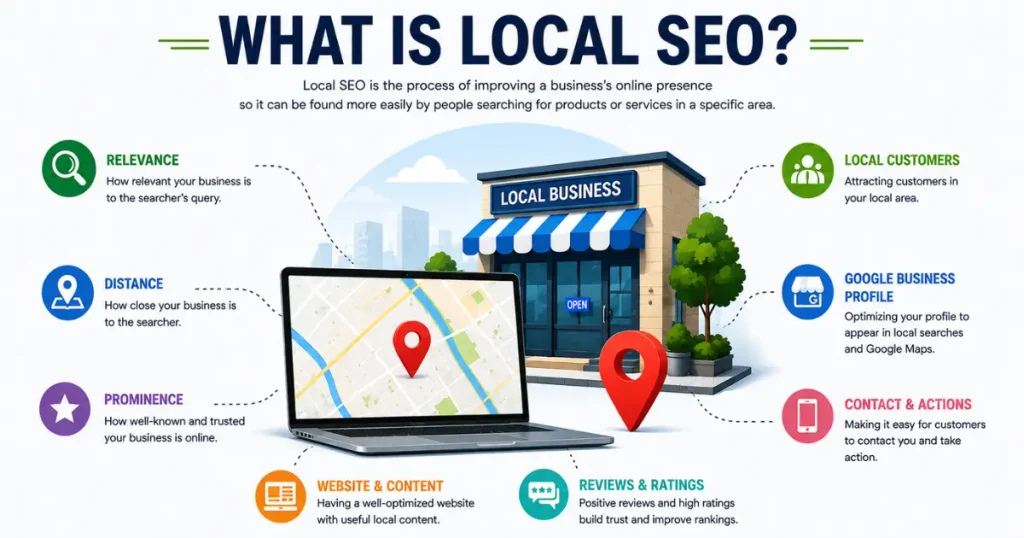
For example, a person searching for:
- plumber in Islamabad
- electrician near me
- dentist in Lahore
- AC repair Karachi
- restaurant near me
is making a location-related search.
The search engine needs to determine which businesses are relevant to the query and which ones are useful options for that particular searcher.
That means local visibility isn’t simply about putting a city name on every page of your website. It involves several connected signals, including your business information, services, location, website content, reviews, and overall online presence.
The goal is straightforward: make it easier for the right local customer to discover, understand, and contact your business.
Why Local SEO Matters for Small Businesses
Most small businesses serve customers within a limited geographic area.
A plumber in Islamabad doesn’t need visitors from every country in the world. The person who matters is the homeowner or business nearby who needs plumbing work.
This makes local search different from broad informational SEO.
Someone searching:
“How to fix a leaking tap”
may simply be looking for information.
Someone searching:
“Emergency plumber Islamabad”
has a much stronger possibility of needing a service.
That difference in search intent matters.
A strong local presence puts your business right in front of people ready to buy. It makes it easy for them to call you, visit your website, or get directions. After all, real phone calls matter much more than just website visits.
How Google Local Search Works
Google uses different factors to decide which local businesses fit a search.
Three concepts are particularly useful to understand:
Relevance
Google checks whether a business actually matches what the person is searching for.
If someone searches for an electrician, a plumbing company won’t be relevant—even if it is located right next door to the searcher.
Your business category, services, website content, and business details all help communicate what you actually offer.
Distance
Location can also matter.
A business that serves an area close to the searcher’s location may be more relevant than one much farther away, depending on the query and the type of business.
This doesn’t mean you can simply create fake locations to appear in more places. Your online presence should accurately represent where your business operates.
Prominence
Google also considers signals that help it understand how established or well-known a business is.
Reviews, mentions, links, and other information across the web can contribute to a business’s overall online presence.
These factors work together rather than acting like a simple checklist where completing one item guarantees a particular ranking.
Local SEO for Small Businesses: The Core Strategy
There isn’t one setting you can switch on to make a business dominate Google Maps.
A better approach is to build a consistent local presence across your Google Business Profile, website, reviews, content, and relevant online references.
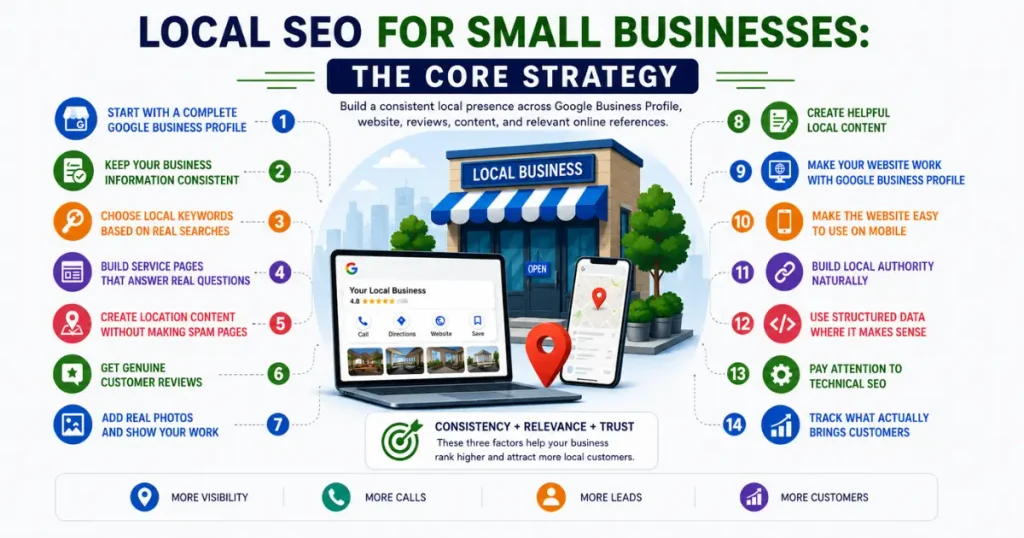
Let’s break that process down.
Start With a Complete Google Business Profile
For many local businesses, the Google Business Profile is often the first spot where potential customers find them.
It can show information such as:
- Business name
- Category
- Phone number
- Website
- Opening hours
- Service information
- Photos
- Reviews
- Location or service area
Take the time to complete the profile accurately.
Pick a category that best describes your actual business, rather than just choosing a popular one.
Your business description should explain what you do straightforwardly.
For example, a plumbing company could explain the types of plumbing services it provides and the areas it genuinely serves.
Avoid turning the description into a long list of keywords.
The purpose is to help both customers and search engines understand the business.
Our local SEO for small businesses strategies combine Google Business Profile optimization, useful website content, local search optimization, and reputation building.
Keep Your Business Information Consistent
Imagine that your business phone number is different on three websites.
One listing shows:
0300-1234567
Another shows:
0301-7654321
And your website contains a third number.
That creates unnecessary confusion.
Important business details should be kept accurate wherever your business is represented online.
Pay particular attention to:
- Business name
- Phone number
- Address, where applicable
- Website
- Opening hours
- Service information
Consistency is especially important when your business appears in directories, industry websites, social profiles, and other relevant sources.
You don’t need to submit your business to hundreds of random directories. Focus on sources that are legitimate, relevant, and useful.
Choose Local Keywords Based on Real Customer Searches
Keyword research still matters in local SEO, but the goal isn’t to repeat a city name dozens of times.
Think about how your customers actually describe the problem or service they need.
A plumber might target topics around:
- emergency plumbing
- pipe repair
- bathroom plumbing
- water leak repair
- geyser installation
- drain cleaning
Then consider how location changes the intent:
- emergency plumber Islamabad
- pipe repair Islamabad
- geyser repair Islamabad
- drain cleaning Islamabad
You can also look beyond exact phrases.
Searchers may use different wording to describe the same need. Local SEO for small businesses should focus on these natural search variations instead of repeating the same exact keyword in every paragraph.
Build Service Pages That Answer Real Questions
A single page doesn’t have to cover every service you offer.
If you provide multiple services, creating individual pages gives a far better experience.
For example, a plumbing company might have:
Plumbing Services
Emergency Plumbing
Geyser Installation
Drain Cleaning
Water Leak Repair
Each page can explain:
- What the service involves
- When a customer might need it
- What problems it solves
- How the business handles the work
- Areas served
- How to request the service
This gives visitors useful information before they contact the business.
It also creates a clearer structure for search engines to understand the relationship between the business and its services.
Create Location Content Without Making Spam Pages
Location pages can be useful when a business genuinely serves multiple areas.
But there is an important difference between useful location pages and hundreds of pages where only the city name changes.
For example, a plumbing company serving Islamabad and Rawalpindi might create genuinely useful pages explaining the services available in each area.
A weak approach would be:
Plumber in Islamabad Plumber in Rawalpindi Plumber in Lahore Plumber in Karachi Plumber in Multan…
with almost identical text on every page.
That adds little value.
A better location page should contain information that is genuinely useful for customers in that area, such as:
- Services available there
- Actual service coverage
- Relevant projects or examples
- Local customer questions
- Travel/service information
- Contact details
Only create a location page when you have something useful to say about that location.
Get Genuine Customer Reviews
Reviews are important because customers often use them when deciding which local business to contact.
After completing a job, you can ask a satisfied customer to share an honest review.
Don’t try to manufacture a perfect review profile.
Instead, focus on delivering good service and making it easy for real customers to share their experiences.
Respond to reviews professionally.
A negative review doesn’t necessarily mean your business is finished. A calm, helpful response can show potential customers how you handle problems.
For example, instead of arguing publicly, you can acknowledge the customer’s concern and invite them to contact the business so the issue can be investigated.
That is much more useful than filling your profile with generic responses.
Add Real Photos and Show Your Work
A local SEO for small businesses becomes easier to trust when potential customers can see evidence of the work.
A plumber can show:
- Completed repairs
- Bathroom installations
- Pipework
- Geyser installations
- Before-and-after projects
- Team members working
An electrician could show:
- Wiring projects
- Lighting installations
- Electrical panels
- Completed commercial work
- Safety equipment
These images don’t need to look like professional advertising campaigns.
Authentic photos from real work can often communicate more than generic stock photography.
Make sure you have permission to use customer or project photos when necessary.
Create Helpful Local Content
A blog can support a local SEO strategy when the content answers questions that your potential customers actually have.
For example, a plumber could publish:
- How to Tell If You Have a Hidden Water Leak
- What to Do When a Drain Is Completely Blocked
- How Often Should a Home Geyser Be Serviced?
- Common Plumbing Problems in Older Homes
- When Should You Call an Emergency Plumber?
Notice that these topics don’t need to repeat the business location in every sentence.
The content should first be useful.
If location is important, share specific details about the areas you serve.
This creates a healthier content strategy than publishing dozens of nearly identical articles with different city names.
Make Your Website Work With Your Google Business Profile
Your Google Business Profile and website shouldn’t feel like two completely separate marketing channels.
They should support each other.
When someone discovers your business through Google Maps, they may visit your website before calling.
Your website should quickly answer basic questions:
What does this business do?
Where does it operate?
Why should I trust it?
How can I contact it?
A local service landing page can include:
- Clear headline
- Main services
- Service areas
- Real photos
- Customer reviews
- Business information
- Phone number
- WhatsApp/contact option
- Clear call to action
Don’t make visitors search through five pages just to find your phone number.
For many local businesses, the website’s job is simple: turn local search visibility into a useful customer experience.
Make the Website Easy to Use on Mobile
Local searches often happen when people are away from a desktop computer.
Someone may search for a mechanic while standing beside their car or look for a plumber while dealing with a plumbing emergency.
If your website is difficult to use on a phone, you can lose that potential customer even after successfully getting them to your page.
Check that:
- Text is easy to read
- Buttons are easy to tap
- Images don’t break the layout
- Pages load efficiently
- Navigation is simple
- Contact information is obvious
- Forms work properly
Think about the customer’s situation rather than just how the website looks on your own computer.
Build Local Authority Naturally
Links and mentions can help establish a business’s broader online presence. But local link building should focus on relevance rather than volume.
Depending on your business, legitimate opportunities may include:
- Local organizations
- Industry associations
- Community websites
- Local publications
- Business partnerships
- Relevant directories
- Sponsorships or community involvement
Don’t buy huge packages of unrelated backlinks simply because someone promises hundreds of links for a small fee.
A link from a relevant, trustworthy source is generally more meaningful than a large collection of random links.
The same principle applies to citations.
Quality and relevance matter more than collecting every directory listing you can find.
Use Structured Data Where It Makes Sense
Structured data can provide additional information to search engines about the content and entities represented on a page.
For eligible content, this may help search engines understand details such as:
- Business information
- Products
- Services
- Articles
- Events
- Other supported content types
However, adding schema doesn’t guarantee that Google will display a rich result.
The markup must match what people actually see on the page and follow Google’s guidelines.
For a local business, structured data should fit into your overall technical SEO plan—not used just because it sounds fancy.
Pay Attention to Technical SEO
Local SEO still depends on having a website that search engines can access and understand.
Check the basics:
- HTTPS
- Mobile usability
- Crawlable pages
- Logical site structure
- Descriptive page titles
- Useful meta descriptions
- XML sitemap where appropriate
- Broken links
- Redirects
- Page performance
- Indexing issues
You don’t need an incredibly complicated website.
In fact, many local businesses can benefit from a simple site that works reliably and clearly communicates the important information.
Technical SEO should support the content rather than become a project that never ends.
Track What Actually Brings Customers
Ranking positions are useful, but they’re not the whole story.
A business owner ultimately wants customers.
Track things such as:
- Calls
- Contact form submissions
- WhatsApp enquiries
- Website visits
- Direction requests
- Search queries
- Pages receiving organic traffic
- Leads from local searches
You may discover that one service page generates far more enquiries than another.
That information can guide your future content and SEO work.
For example, if your service page brings in real leads but a blog post only brings clicks, put more focus on the page that actually converts.
SEO becomes much more useful when you connect visibility with actual business outcomes. We focus on practical local SEO for small businesses that helps improve visibility without relying on complicated or outdated SEO tactics.
Common Local SEO Mistakes to Avoid
Local optimization can go wrong when businesses focus too much on shortcuts. Our goal with local SEO for small businesses is simple: help the right customers find the right business at the right time.
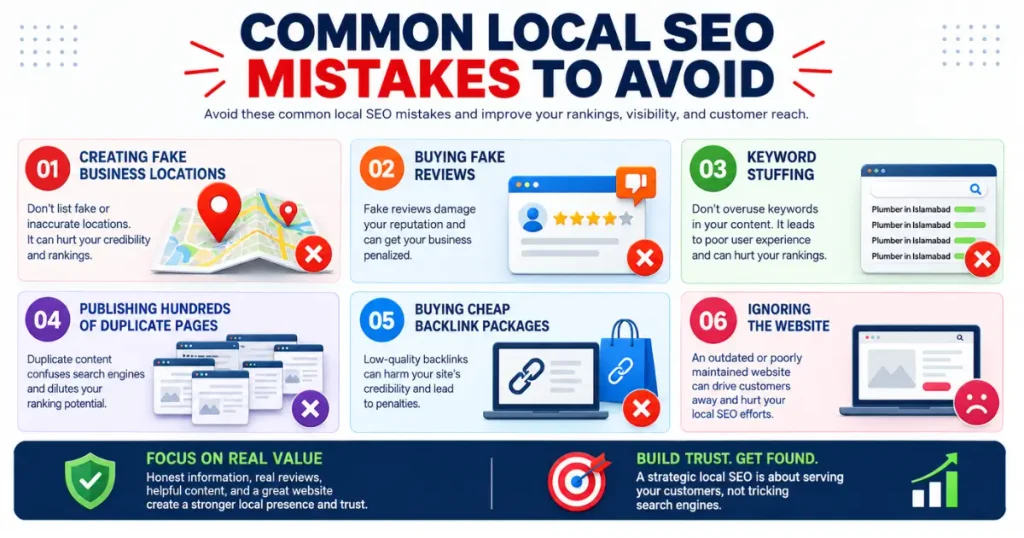
Let’s discuss some of the most common local SEO for small businesses mistakes you should avoid:
Creating fake business locations
Creating fake locations is a common mistake in local SEO for small businesses. Don’t create or list locations where your business doesn’t genuinely operate just to appear in more local searches. Focus on the areas you actually serve and build your local presence around genuine locations.
Buying fake reviews
Buying fake reviews is a common mistake in local SEO for small businesses. Fake or misleading reviews can damage customer trust and may violate Google and other platform policies. Instead, focus on providing a good customer experience and encouraging genuine customers to share honest feedback.
Keyword stuffing
Repeating the same city or service keywords throughout a page does not automatically improve its ranking. In fact, excessive keyword repetition can make your content feel unnatural and difficult to read. Use relevant keywords naturally and focus on creating clear, helpful content that answers your customers’ questions.
Publishing hundreds of duplicate pages
Creating hundreds of similar pages with only the location name changed is a common local SEO mistake. These pages often provide little or no additional value to visitors and can make your website content feel repetitive. Instead, create genuinely useful local content that offers relevant information for each area you serve.
Buying cheap backlink packages
Buying cheap backlink packages can be a risky SEO mistake, especially when they contain large numbers of irrelevant or low-quality links. These links may provide little value and can make your website’s backlink profile look unnatural. Focus on earning relevant, trustworthy links from reputable websites instead.
Ignoring the website
Ignoring your website is another common local SEO mistake. A well-optimized business profile may bring potential customers to your website, but the website still needs to provide clear information, build trust, and make it easy for visitors to call, request a quote, or get in touch.
In local SEO for small businesses, even small mistakes can affect your local visibility and make it harder for potential customers to find your business. These issues can lower your chances of ranking well in local search and prevent your business from getting the calls, leads, and customers it could otherwise gain online. By avoiding these common mistakes and keeping your local SEO efforts accurate and consistent, you can build a stronger online presence and get more value from local search.
A Simple Local SEO Checklist
If you’re starting from scratch, don’t try to fix everything at once.
Start with the basics.
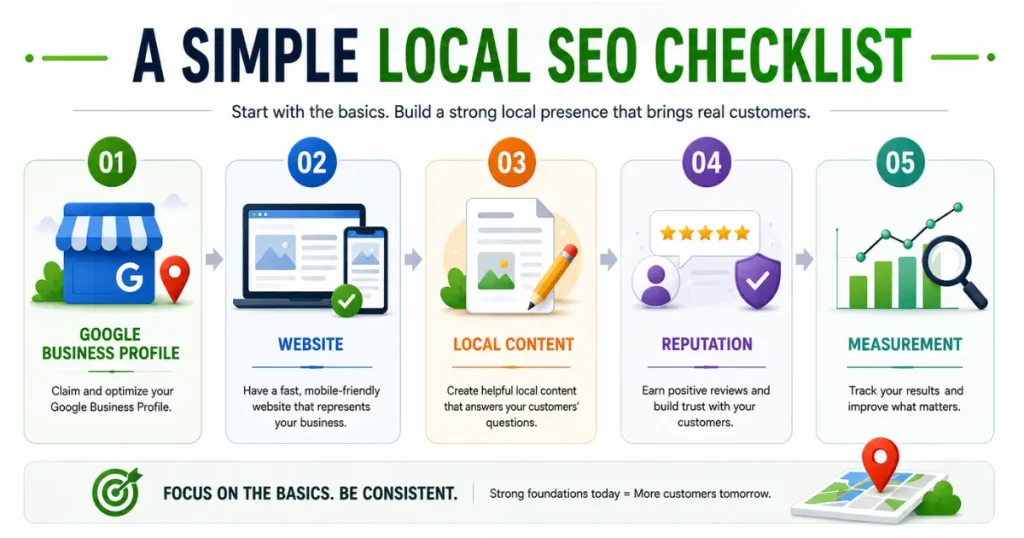
Google Business Profile
- Complete business information
- Accurate category
- Correct hours
- Relevant services
- Genuine photos
- Customer reviews
- Updated information
Website
- Mobile-friendly design
- Clear service pages
- Service area information
- Contact details
- Fast and usable pages
- Helpful content
- Internal links
- Basic technical SEO
Local Content
- Answer real customer questions
- Cover important services
- Address relevant local topics
- Avoid duplicate location pages
- Update outdated information
Reputation
- Encourage genuine reviews
- Respond professionally
- Use real project photos
- Keep business information consistent
Measurement
- Monitor organic traffic
- Track enquiries
- Review search queries
- Watch important pages
- Measure leads rather than rankings alone
By following these basic simple checklist steps, local SEO for small businesses becomes easier to manage and more effective over time. Keeping your Google Business Profile, website, local content, reputation, and performance data up to date can help improve your local visibility and connect your business with more potential customers. The goal is not just to rank higher, but to turn local searches into real calls, enquiries, and customers.
How Long Does Local SEO Take?
One of the most common questions business owners ask is how quickly they will see results.
There isn’t a universal timeline.
A new business with little online presence may need time to build visibility and trust. An established business with a strong profile, good reviews, and helpful content will see results much faster.
Competition also matters.
Ranking for “plumber in a small town” can be very different from competing for a broad term in a major city.
Instead of expecting instant results, look for gradual improvements:
- More relevant impressions
- Better visibility for local searches
- More website visits
- More calls
- More enquiries
- Stronger customer engagement
The important thing is to measure progress against the actual business goal. With local SEO for small businesses, we help businesses build a stronger local presence and turn more local searches into genuine leads and customers.
Final Thoughts
Local SEO is not about finding a secret trick that guarantees the number-one position on Google.
It’s about making your business easier to understand, easier to discover, and easier to trust.
Start with accurate business information. Build a useful Google Business Profile. Create service pages that answer real customer needs. Encourage genuine reviews. Show your actual work. Keep your website useful on mobile devices, and build local authority through relevant content.
Most importantly, don’t optimize everything for search engines while forgetting the person who is actually going to hire you.
If someone searches for a plumber, electrician, dentist, or another local service, they want confidence that they’ve found the right business.
Good local SEO helps you become easier to find. A good customer experience gives people a reason to choose you.
At Rameez Digital Hub, we help small businesses improve their online visibility through local SEO for small businesses, SEO, local search optimization, Google Business Profile optimization, website optimization, and digital marketing strategies.
If your business is difficult to find when local customers search for the services you provide, improving your local presence can be a practical place to start.